
The cheapest WooCommerce store I have ever shipped cost $0 in software and $7,400 in my time. That gap between the headline and the invoice is what every guide answering “is WooCommerce free” refuses to put on paper. Yes, the plugin at wordpress.org/plugins/woocommerce is free and always will be. No, that does not make your store free. After 8 years building WooCommerce stores for clients across three continents, I have a folder of cost spreadsheets that disagree with the marketing pages on both sides, Shopify and Automattic. So when somebody asks me that question, the honest answer is “yes, the way a car is free if you already own a garage, tools, fuel, and know how to change the oil.” This article puts numbers on every line.
Most “is WooCommerce free” articles online are written to convert traffic into hosting affiliate clicks. The truth is more nuanced and more useful from the operator side, and that is what the next 2,500 words cover.
Is WooCommerce Free? The Plugin Itself, Yes, Everything Around It, No
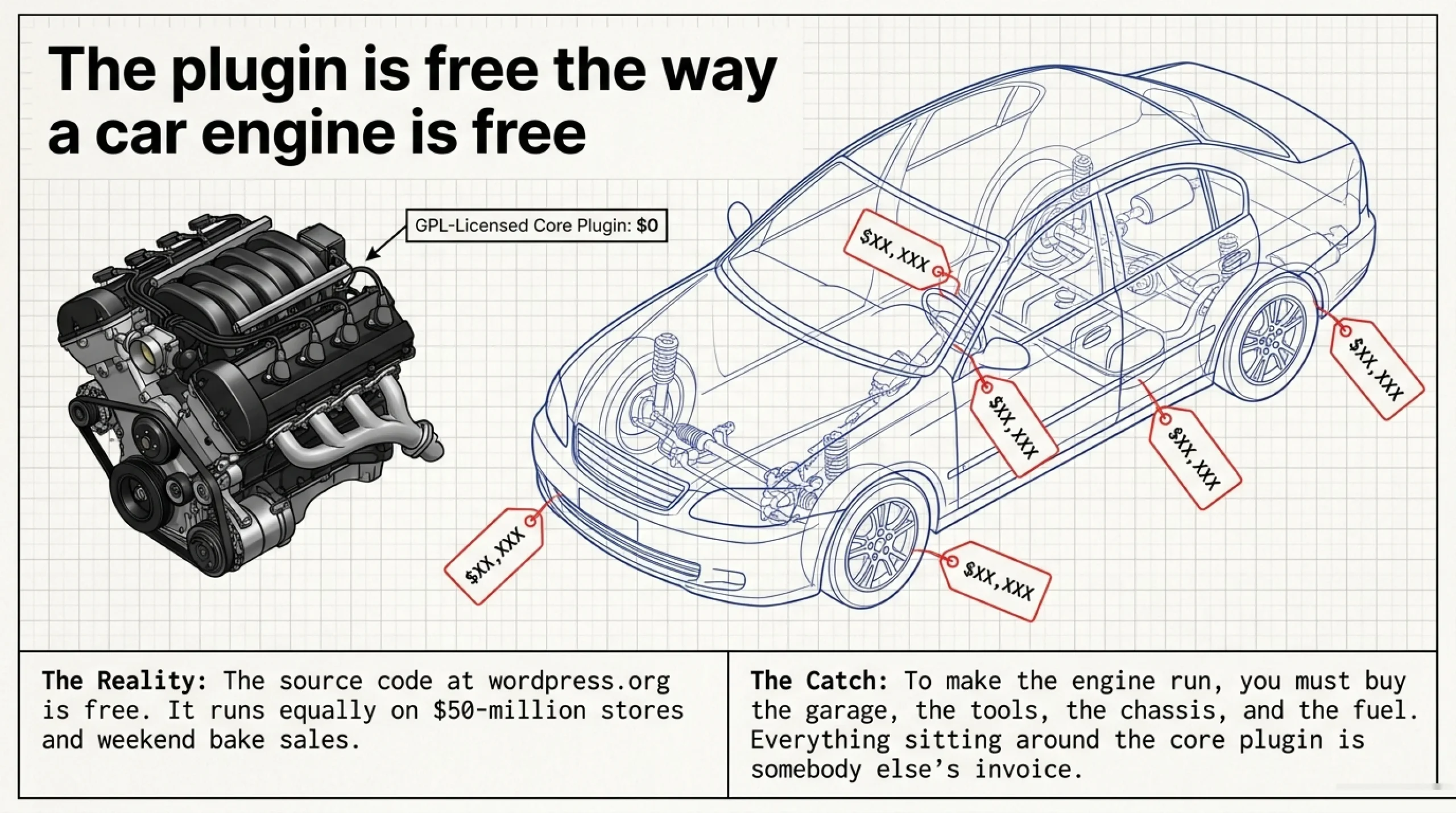
Start with the literal answer. The WooCommerce plugin is GPL-licensed, downloadable from the official directory at wordpress.org/plugins/woocommerce, and you can install it on any WordPress site without paying Automattic anything. The same source code runs on the $50-million-a-year fashion store I rebuilt last spring and on the bake-sale storefront somebody set up last weekend. There is no feature gate behind a paywall in the core plugin. None.
What costs money sits around the plugin: WordPress hosting, a domain, an SSL certificate (free via Let’s Encrypt, but somebody has to configure it), payment processor fees, and any premium extensions you actually need to run your specific business. The WooCommerce plugin charges $0 for software. WordPress charges $0 for software. Everything else is somebody else’s invoice, and the question of how much does WooCommerce cost in practice is really a question about that surrounding stack.
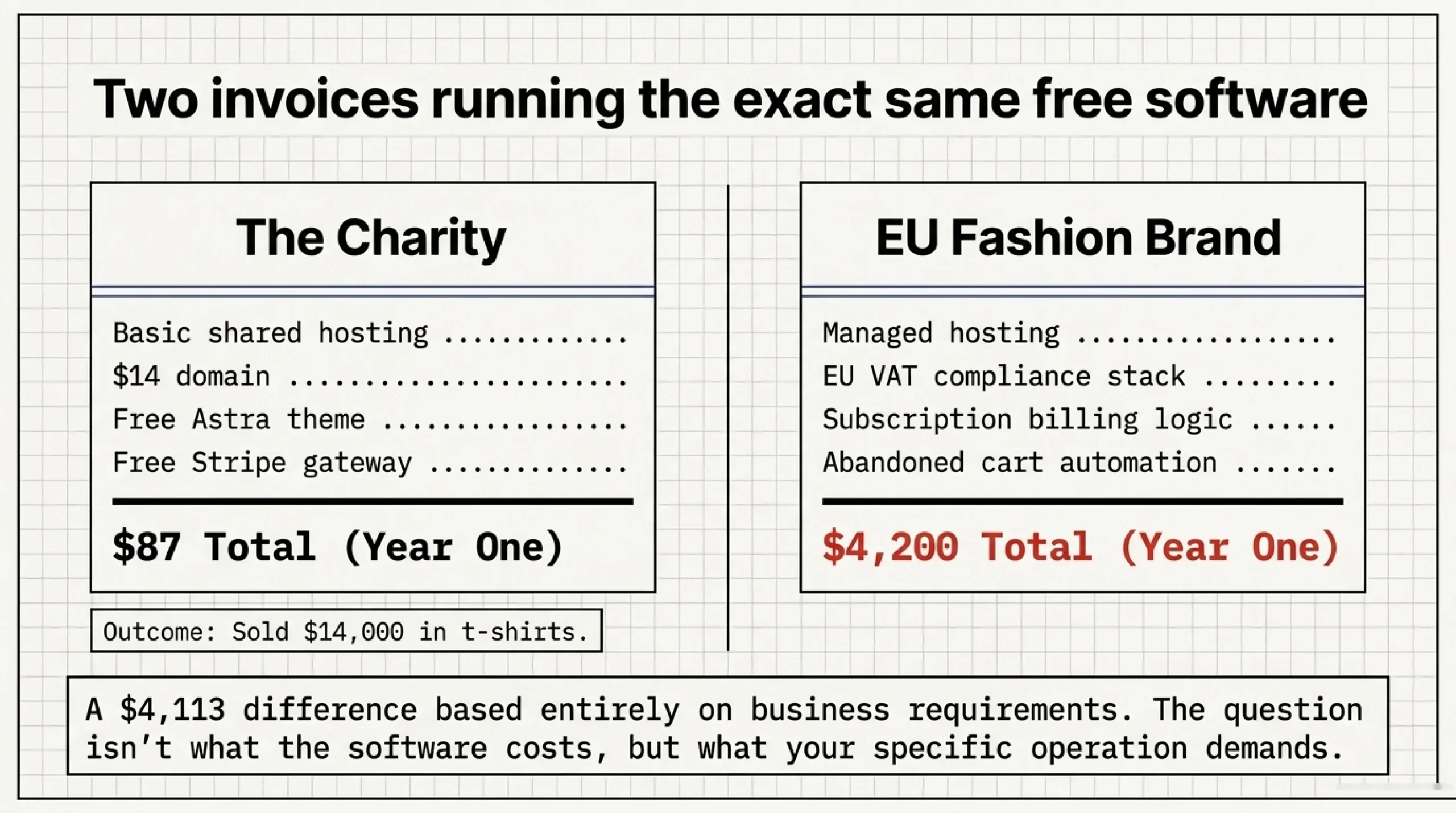
Two real cases from the last 24 months. A charity client in 2023 ran a t-shirt fundraiser on basic shared hosting for $87 total in year one: domain, hosting, free Astra theme, free Stripe gateway. Sold $14,000 in shirts. Is WooCommerce free for that store? Practically, almost yes. A fashion brand I onboarded last March, running a subscription model with full EU VAT compliance plus abandoned cart automation, spent $4,200 in year one before we ever processed a payment.
Same software, $4,113 difference. That is the actual answer to “is WooCommerce free” in any honest form.
How Much Does WooCommerce Cost When You Add the Stack
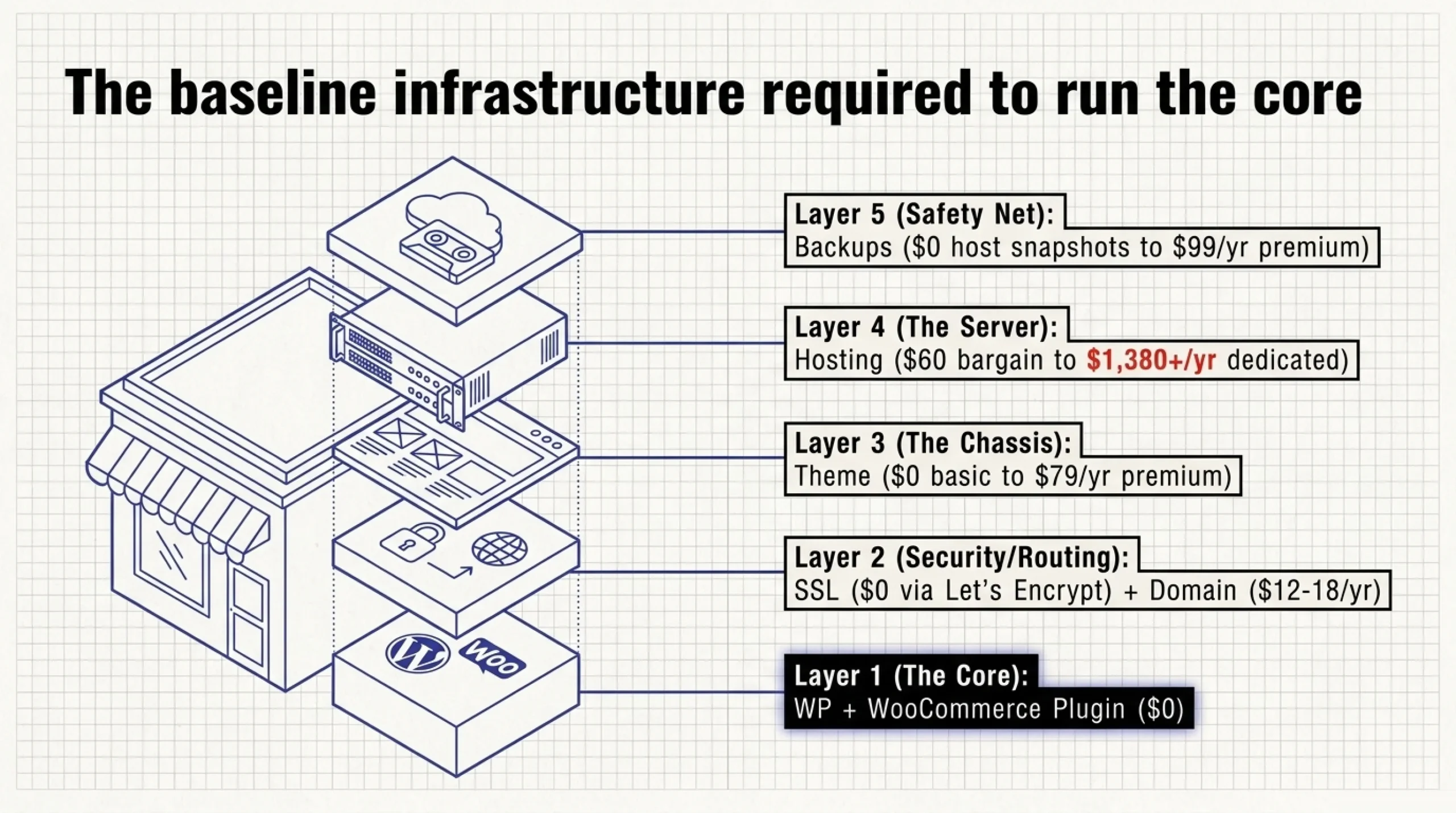
If you want a real number on how much does WooCommerce cost in 2026, here is the line-item breakdown I pull when I scope client projects.
- Domain: $12-18/year on Namecheap or Porkbun. Skip the $20+ tiers; they are the same domain at the same registry.
- Hosting:
- Bargain shared: $5-10/month at Hostinger or SiteGround StartUp. Works under 50 orders/day.
- Managed WP: $35/month at Kinsta Starter. The boundary I tell clients to cross around 100 orders/day.
- Dedicated WC hosting: $70-115/month at Kinsta Pro or WP Engine eCommerce.
- SSL: $0 via Let’s Encrypt. Every serious host installs it automatically. If yours does not, switch hosts.
- Theme: $0 (Storefront, Astra free, GeneratePress free) to $79/year (Astra Pro). Most production stores I run use the free version.
- Backups: $99/year for UpdraftPlus Premium, or free if your host does daily snapshots. Check before paying.
A pet peeve before going further. Every “WooCommerce hosting comparison” listicle ranks the host that paid the affiliate the highest. I have shipped real client stores on Kinsta, WP Engine, SiteGround, and Cloudways since 2024. None of them is “the best”, they each break in different ways under different traffic patterns, and the one that broke last is usually whichever one the writer remembers most recently.
Realistic totals on how much does WooCommerce cost before extensions and processor fees:
- DIY-everything floor: $90-110/year.
- Comfortable professional setup: $700-900/year.
- High-traffic dedicated stack: $2,000-2,500/year.
That is the number to compare against any Shopify monthly fee, not the $0 in the WordPress plugin directory.
Does WooCommerce Charge Transaction Fees on Sales?
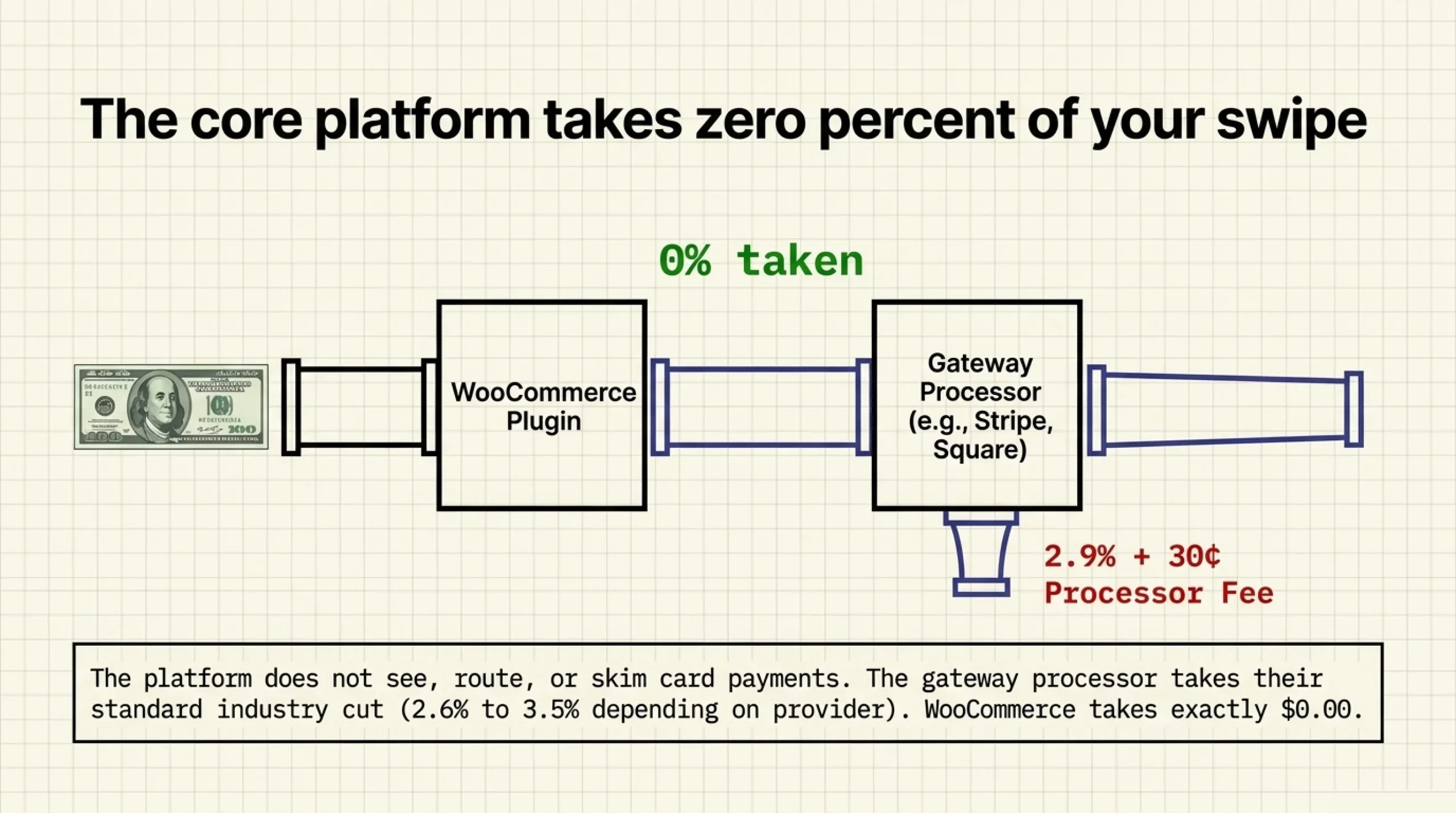
Direct answer. No. WooCommerce charges 0% on every transaction processed through the platform. The plugin does not see, route, or skim your card payments. It hands the data to the gateway you configured, and the gateway charges its own fees.
So if the question “does WooCommerce charge transaction fees” is keeping you up at night because you are comparing against Shopify, breathe. The platform itself takes nothing.
Where the money actually goes per transaction in 2026, from real client invoices:
- Stripe: 2.9% + $0.30 per US card transaction (stripe.com/pricing). Plus 1% for currency conversion. Plus 1.5% for international cards.
- PayPal Standard: 2.99% + $0.49 per online transaction in the US (paypal.com/us/webapps/mpp/merchant-fees).
- Authorize.net: $25/month gateway fee plus 2.9% + $0.30. Almost nobody on WooCommerce uses this anymore; the monthly is hard to justify under $30k/month volume.
- Square: 2.6% + $0.10 for online transactions, often the cheapest if you are already using Square offline.
- Woo Payments: 2.9% + $0.30. It is a Stripe wrapper, same rates by design.
So does WooCommerce charge transaction fees in any direct sense? Still no. The card processor charges 2.6-3.5% of every dollar regardless of which platform sends them the request.
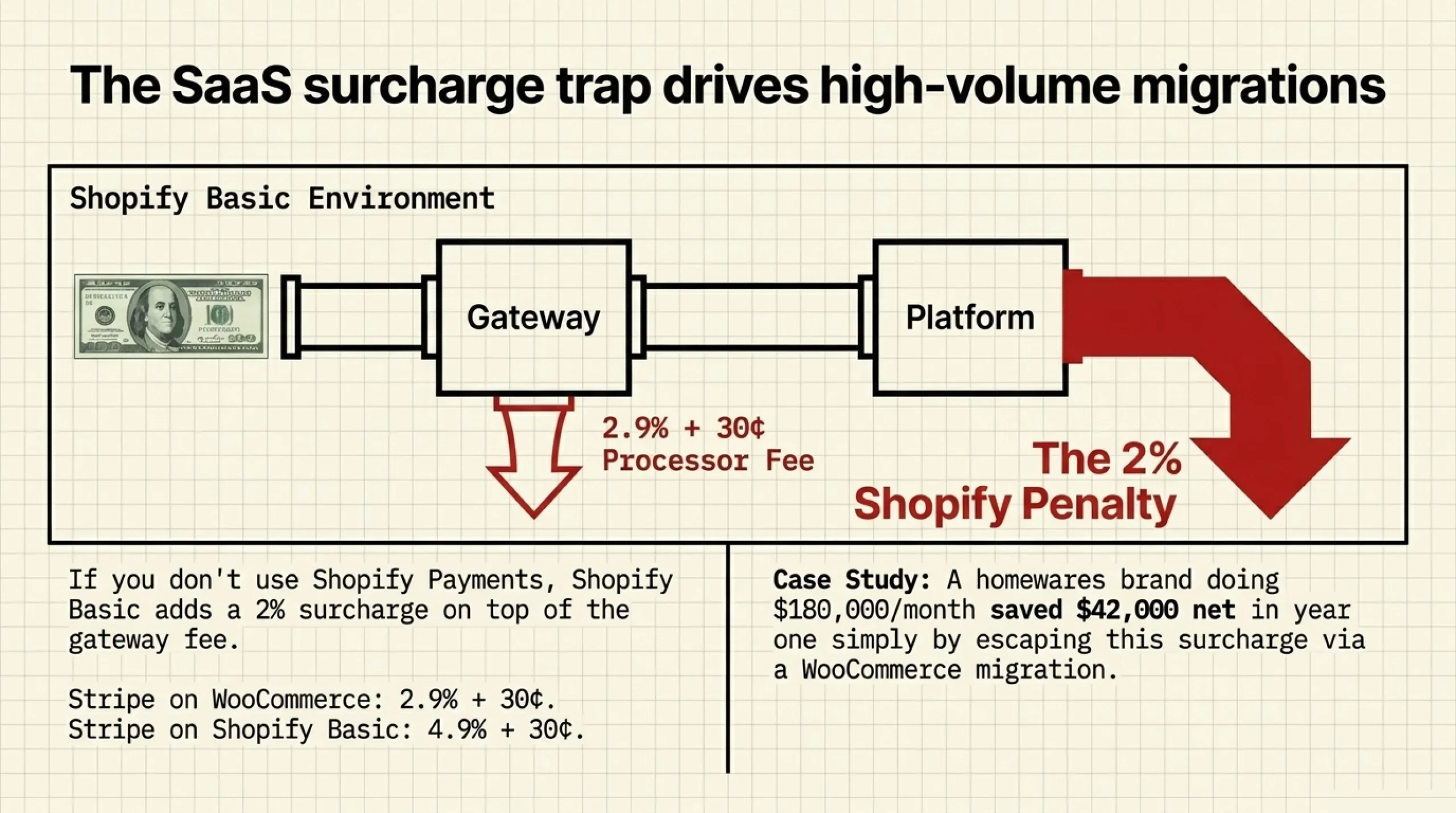
The Shopify comparison matters here. Shopify Basic at $39/month adds a 2% surcharge on top of the processor fee unless you switch to Shopify Payments (help.shopify.com/en/manual/payments/shopify-payments/fees). Use Stripe on Shopify Basic and you pay roughly 4.9% + $0.30 per transaction. Use Stripe on WooCommerce and you pay 2.9% + $0.30. There is no WooCommerce equivalent to that surcharge, and that is the single biggest reason high-volume stores migrate.
A war story to anchor the math. Migrated a homewares brand from Shopify Basic to WooCommerce in February 2025, doing $180,000/month at the time. The Shopify additional fee alone was $3,600/month. They had been told upgrading to Shopify Plus would zero out that surcharge — true, but Plus starts at $2,300/month, so the math only works above ~$300,000 monthly volume. Switching to WooCommerce dropped processor cost to a flat 2.9% on Stripe. Hosting, plugins, and ongoing dev work in year one cost about $9,200. They saved $42,000 net. That is the real answer to does WooCommerce charge transaction fees in the comparison context: the platform charges nothing, and the absence of that 2% surcharge is what funds the migration.
How Much Does WooCommerce Charge for Premium Extensions
This is the section other “is WooCommerce free” articles skip, because it complicates the headline.
Real prices from the official WooCommerce extension store (woocommerce.com/products/woocommerce-subscriptions is one example):
- WooCommerce Subscriptions: $239/year per site.
- WooCommerce Memberships: $199/year per site.
- WooCommerce Bookings: $249/year per site.
- WooCommerce Product Add-Ons: $79/year.
- Stripe gateway, USPS shipping, basic tax: free.
- ShipStation integration: free; ShipStation itself starts at $9.99/month.
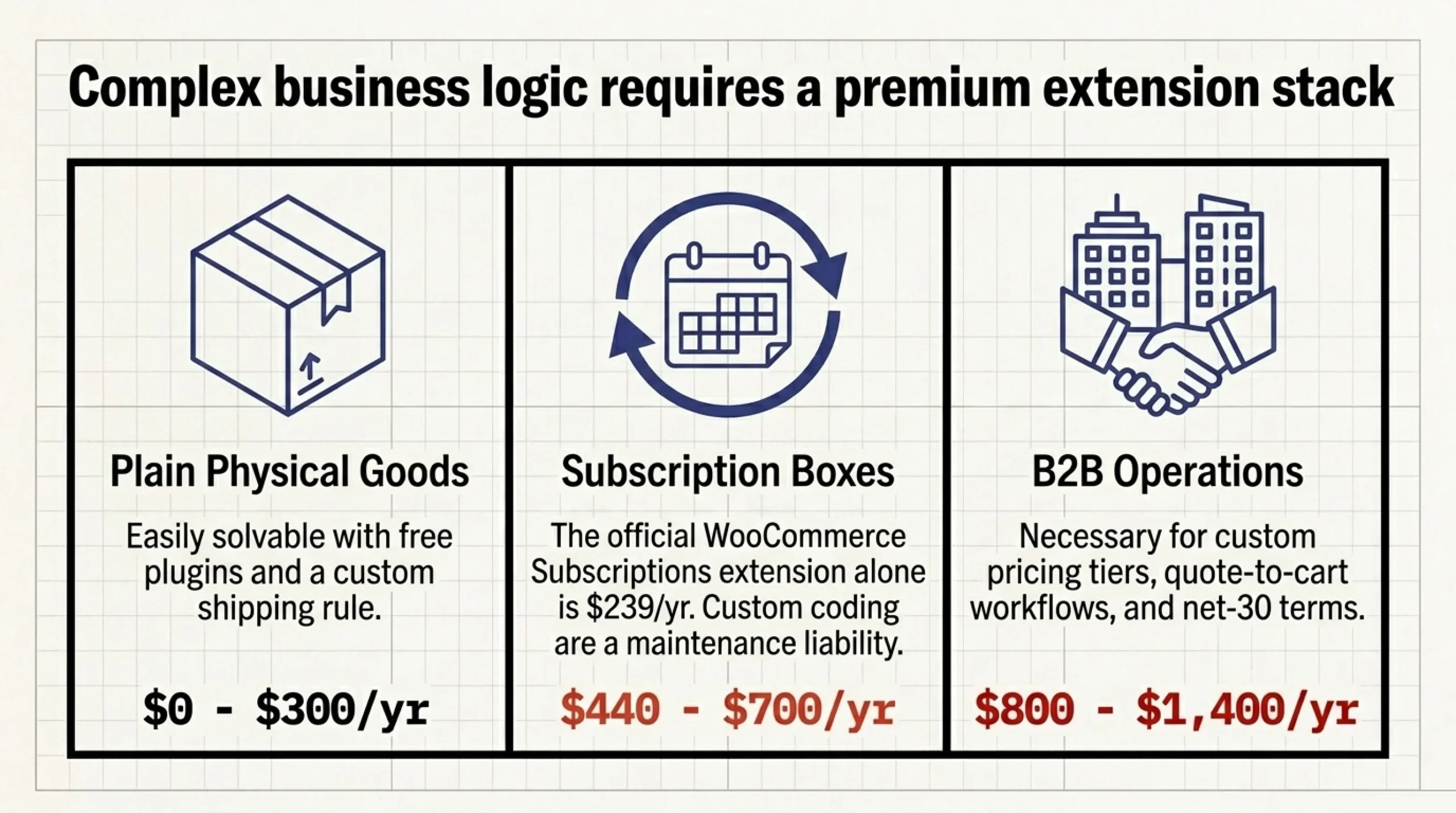
So how much does WooCommerce charge for the extension stack a typical store actually needs? It depends entirely on what you sell and how complicated your billing is.
- Plain physical-products store with abandoned cart recovery and a custom shipping rule: $0-300/year. Most of this is solvable with free plugins.
- Subscription product store (boxes, services, memberships): $440-700/year for the official stack, less if you accept compromises.
- B2B store with custom pricing tiers, quote requests, and net-30 terms: $800-1,400/year.
A disagreement with most “WooCommerce is free” videos. They tell you about the free plugin and never mention that a subscription store needs subscription billing, and the official extension is $239/year. The alternatives are: Sumo Subscriptions on CodeCanyon (~$79 one-time), YITH Subscription ($99/year), or writing recurring billing yourself with a Stripe webhook listener. I have done the third option four times. It is two days of clean work and a maintenance liability that bills you back in support tickets every six months — actually, only if you handle plan changes, otherwise it is fine for fixed monthly subs.
That last sentence is the kind of detail nobody puts in pricing comparisons because it does not fit on a slide.
When you are running a free WooCommerce stack with 30+ active plugins, the WordPress admin sidebar gets unusable. I install BrikPanel on every client store now to hide menu items per user role and keep the dashboard clean. It is free, and unlike most “free” admin plugins it does not bury features behind an upsell. The role-based menu hiding works on the free version with no asterisks.
Is WooCommerce Free Compared to Shopify? The Real Cost Table
Here is the comparison clients actually want when they ask “is WooCommerce free vs Shopify”. 2026 numbers, US store, single currency, no enterprise add-ons. This is also the answer to how much does WooCommerce cost relative to a SaaS competitor at every revenue band.
| Cost item | WooCommerce DIY | WooCommerce Pro | Shopify Basic | Shopify Advanced |
|---|---|---|---|---|
| Platform fee | $0 | $0 | $39/mo | $399/mo |
| Hosting | $84/yr (shared) | $420/yr (Kinsta) | included | included |
| Domain | $14/yr | $14/yr | $14/yr | $14/yr |
| SSL | free | free | included | included |
| Theme | free (Astra) | $59/yr | free or $180-380 once | free or $180-380 once |
| Subscriptions | DIY Stripe (free) | $239/yr extension | $19+/mo app | $19+/mo app |
| Backups | $0 (host snapshots) | $99/yr UpdraftPlus | included | included |
| Per-transaction fee | 2.9% + 30¢ | 2.9% + 30¢ | 2.9% + 30¢ + 2% Shopify | 2.9% + 30¢ + 0.5% Shopify |
| Year-1 software total | ~$98 | ~$1,070 | ~$540 | ~$5,000 |
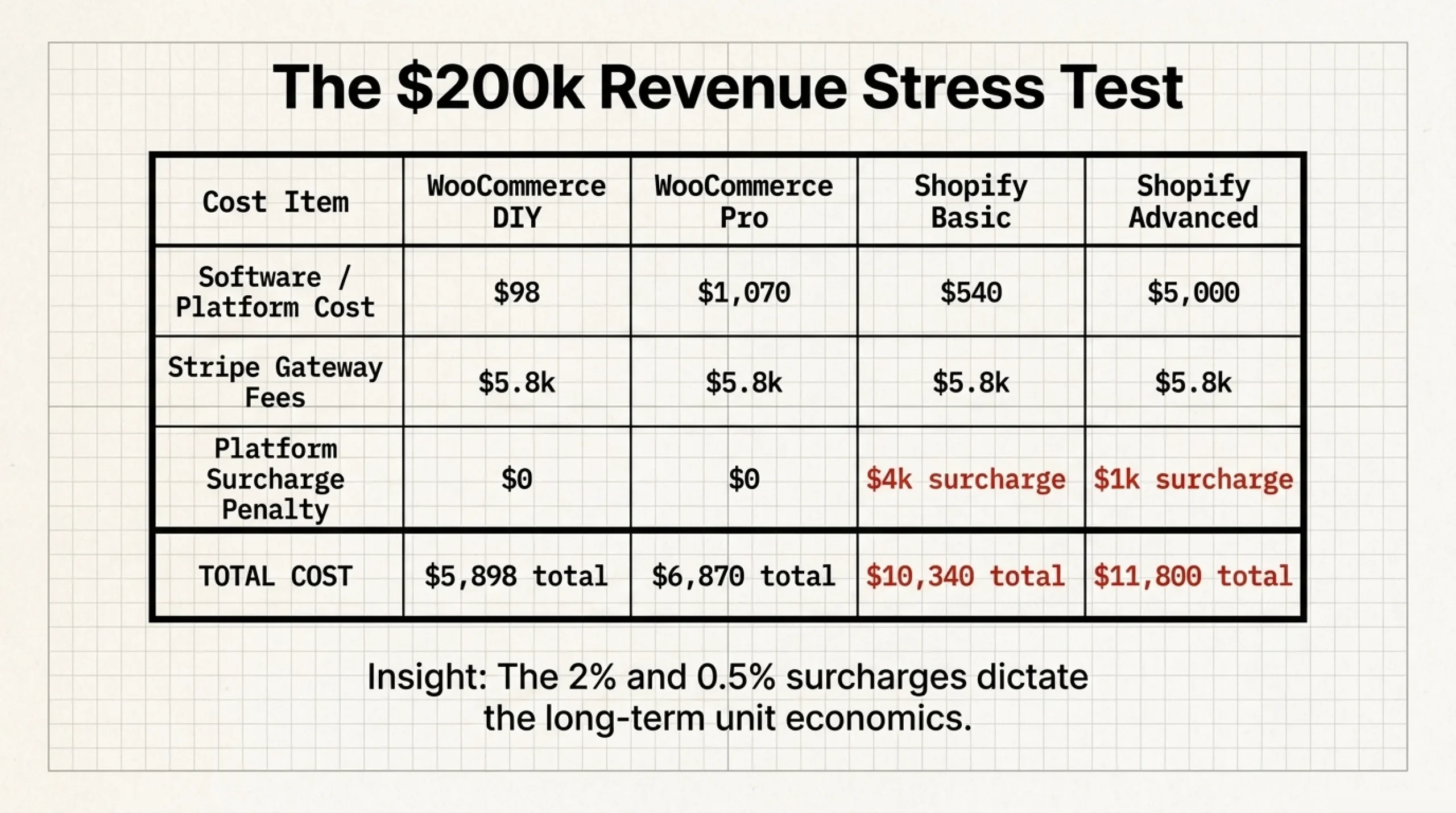
Now the part that matters: cost per $200,000 in revenue (a small but real store):
- WooCommerce DIY: $98 software + ~$5,800 Stripe = $5,898.
- WooCommerce Pro: $1,070 software + ~$5,800 Stripe = $6,870.
- Shopify Basic: $540 + $5,800 Stripe + $4,000 surcharge = $10,340.
- Shopify Advanced: $5,000 + $5,800 Stripe + $1,000 surcharge = $11,800.
Pull the Shopify pricing yourself at shopify.com/pricing before you trust this table. They update it twice a year, and as of 2026 the Basic plan is still $39/month US. The 2% and 0.5% surcharges are the killer numbers for stores that do not use Shopify Payments.
So is WooCommerce free in pure dollar terms? No. Is WooCommerce free relative to Shopify at every revenue band above a few thousand dollars a year? Almost always.
The honest disclaimer. This table ignores time. The DIY column assumes you know WordPress, WooCommerce, and basic server hygiene. If you do not, Shopify Basic is genuinely cheaper than the 40 hours of learning curve at any reasonable hourly rate. I have told three solo founders to stay on Shopify in the last year for that exact reason. Free with no time cost beats free with a learning curve, every time.
Why Use WooCommerce When the Free Version Comes With a Stack
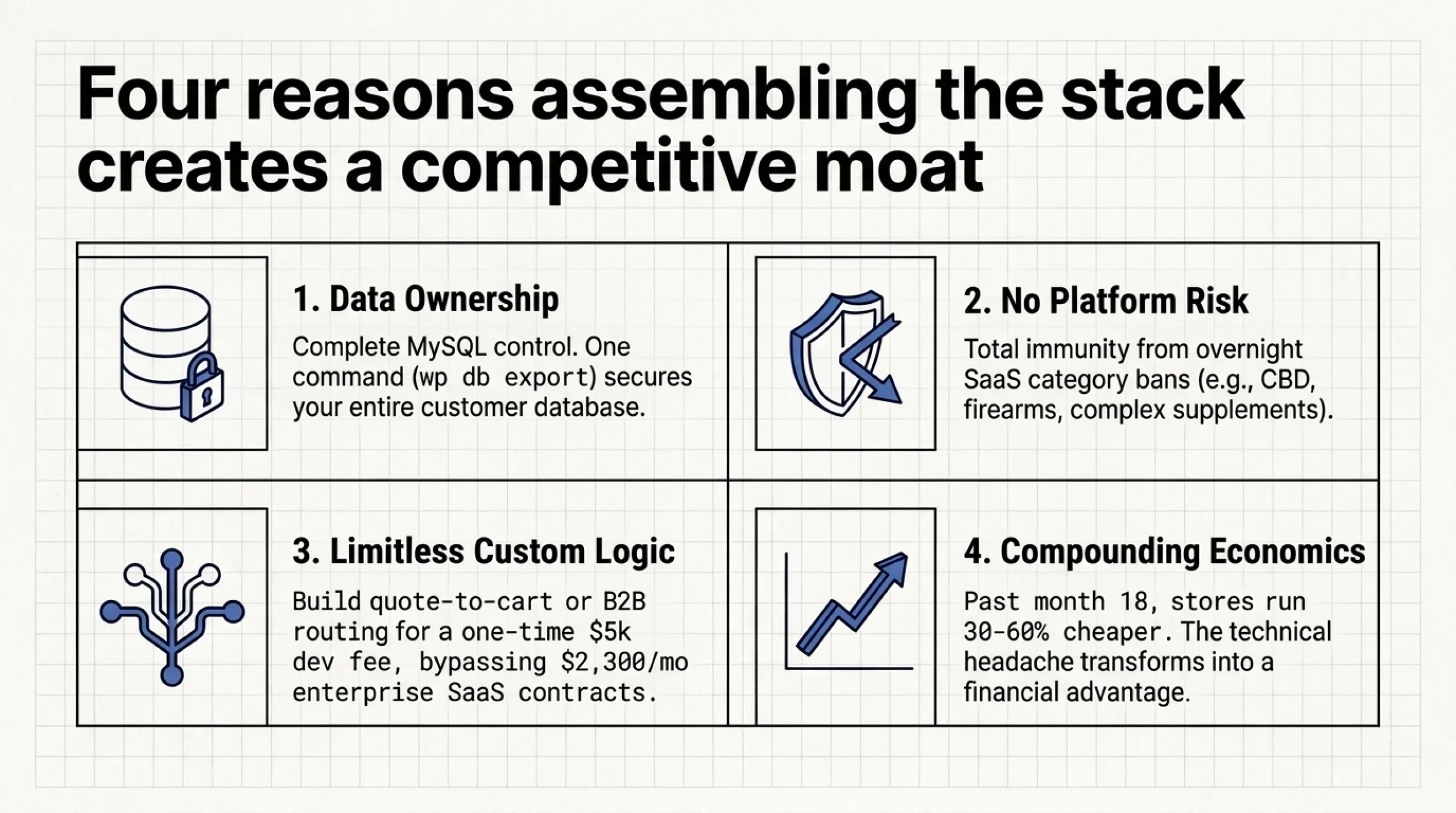
Why use WooCommerce when “free” actually means “you assemble the stack and own every component”? Four reasons that have held up across 8 years of client work.
- Data ownership. Your customer database is in your MySQL, on your server, under your backup policy. One line,
wp db export, and you have everything (developer.wordpress.org/cli/commands/db/export). Try that on Shopify. - No platform risk. Shopify can ban your store category overnight: firearms, CBD, certain supplements, anything legally gray in the US. WooCommerce cannot ban you because there is no central platform to do the banning.
- Custom logic that does not fit a SaaS. Quote-to-cart workflows, B2B credit lines, multi-tier loyalty programs, regional warehouse routing. I have shipped all of these in WooCommerce for under $5,000 of dev work. The Shopify Plus equivalent is a $2,300/month minimum and a partner agency contract.
- Long-term unit economics. Past the second year, WooCommerce stores typically run 30-60% cheaper than equivalent Shopify stores at the same revenue. The compounding shows up around month 18.
The headache compounds into a moat. Every custom hook you write, every database query you understand, every plugin you have read the source of becomes an advantage your competitor on Shopify Basic does not have.
A second BrikPanel mention in context. When you run a free WooCommerce stack with 30+ plugins, the admin gets cluttered fast. I install BrikPanel and use the dashboard widgets feature to put today’s revenue, low-stock count, and pending orders on one screen. Saves 10 minutes per store per day across the 14 client stores I currently maintain. Free in the truest sense; no premium tier on the dashboard customization feature.
When Is WooCommerce Free Actually Worth It?
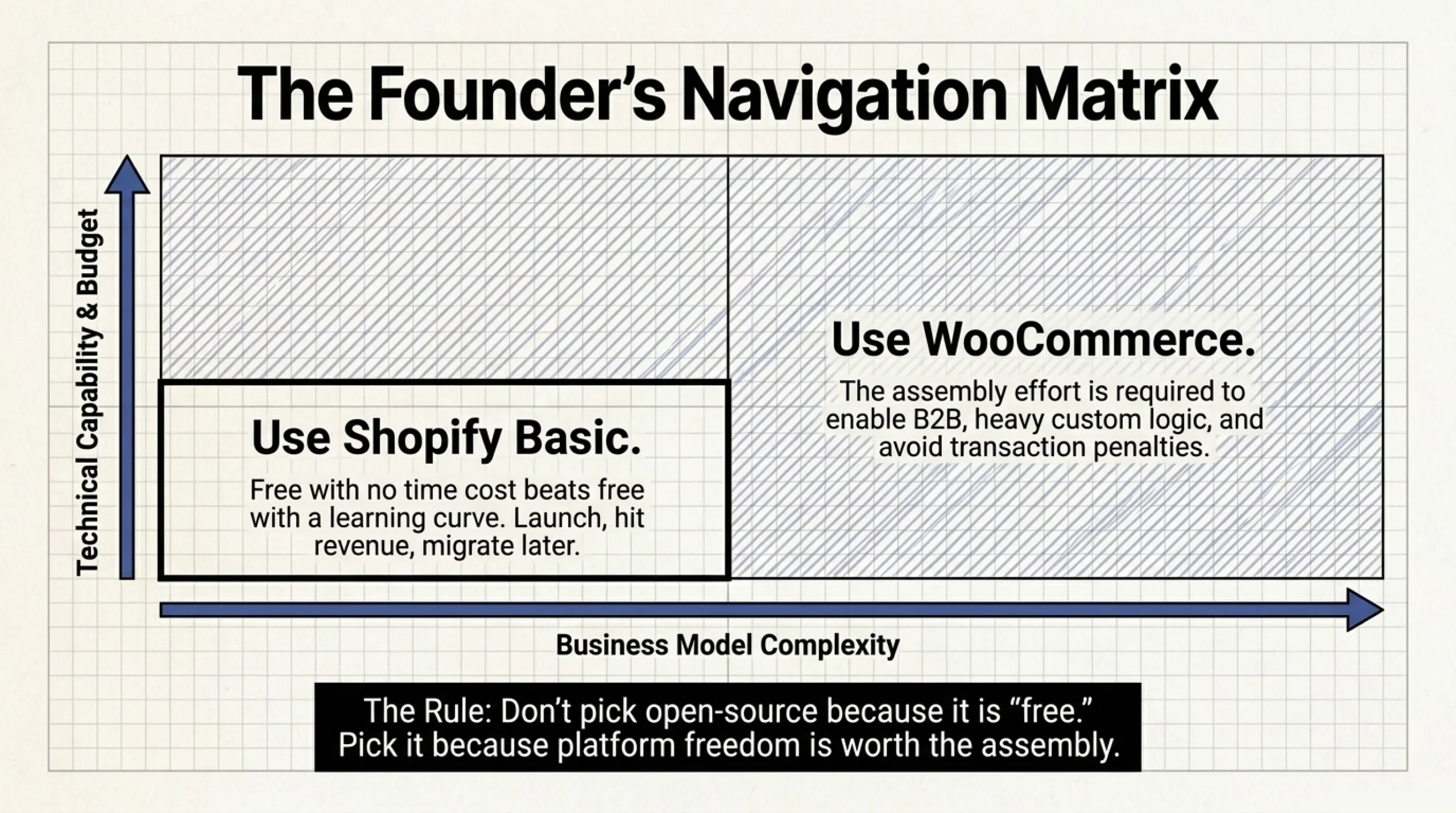
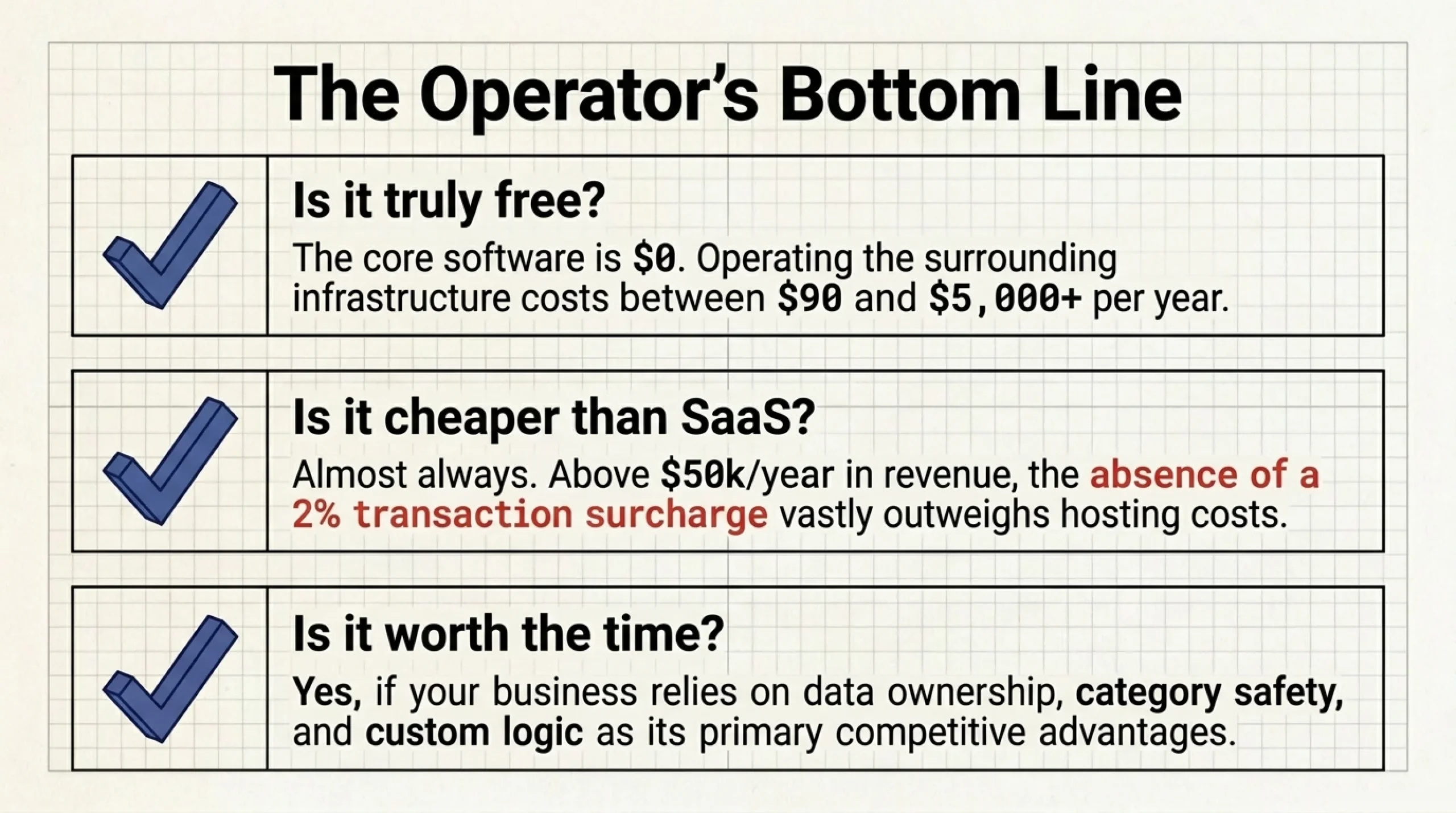
The conditional answer. Is WooCommerce free worth the tradeoff for you?
- Yes if you have any WordPress experience, or budget for one developer day per quarter for maintenance.
- Yes if your revenue model includes anything Shopify charges extra for: custom checkout, B2B pricing, complex shipping logic, restricted product categories.
- No if you are a non-technical solo founder selling 5 products and you need to ship next week. Use Shopify Basic, get to revenue, migrate later. I have done that migration four times. It is straightforward enough once the store has reasons to move.
The wrong reason to choose WooCommerce is “because it is free.” The right reason is “because the platform freedom and data ownership are worth assembling the stack myself.” Those are two different decisions and they get conflated in every comparison article I have read this year.
FAQ
About BrikPanel. BrikPanel is a free WordPress plugin that cleans up the WooCommerce admin: hide menu items per user role, customize dashboard widgets, give clients a tighter login experience without the visual clutter of 30 plugin menus. If you are running a free WooCommerce stack and the admin sidebar has gotten away from you, BrikPanel keeps it under control without adding to your monthly bill. Install it from the directory: wordpress.org/plugins/brikpanel-admin-panel-dashboard-for-woocommerce. Yes, BrikPanel is free, and so is keeping the answer to “is WooCommerce free” honestly affirmative for your store.
Yes. The WooCommerce plugin is GPL-licensed, downloadable from wordpress.org with no feature gates, and the same source code runs on stores doing $50/year and $50 million/year. What costs money sits around the plugin: WordPress hosting ($60-1,200/year depending on tier), a domain ($14/year), payment processor fees (2.9% + 30¢ on Stripe), and optional premium extensions like WooCommerce Subscriptions ($239/year). So is WooCommerce free in the absolute sense? No, but the platform itself charges you nothing.
A realistic small store runs $15-30/month all-in: $7 hosting, $1 domain amortized, free SSL, free theme, occasional plugin licenses spread over the year. A professional store with managed hosting and 4-5 paid extensions runs $80-120/month. I have not seen a real WooCommerce store under my care cost less than $60/year or more than $5,000/year before payment processor fees, so anywhere in that band is normal.
No. WooCommerce takes 0% of your transactions. The plugin does not see, hold, or route the money. The card processor (Stripe, PayPal, Square, Authorize.net) charges 2.6-3.5% per sale, but those fees are identical on Shopify, BigCommerce, or any platform using the same processors. Shopify additionally charges a 0.5-2% surcharge on top if you do not use Shopify Payments; WooCommerce has no equivalent surcharge.
Functionally, no. You can install the plugin without knowing PHP, but the moment something breaks (and something always breaks) the cost is either learning hours or a developer at $75-150/hour. I have told several non-technical founders to use Shopify for the first 18 months and migrate later. The time-cost of “free” outweighs the platform fee until they hire someone who knows the stack. Is WooCommerce free in the practical, usable sense for non-technical solo founders? Often not.
Three real reasons hold up: data ownership (your store lives in your database, not on a SaaS that can lock you out), no platform risk (Shopify can ban entire product categories without warning), and lower total cost above ~$50,000/year revenue once Shopify’s transaction surcharge stacks. Below that revenue band, Shopify Basic is often the right call for non-technical founders.
$239/year per site as of 2026, billed at woocommerce.com/products/woocommerce-subscriptions. There are alternatives: Stripe’s native subscription objects via custom code (free, two days of clean work), Sumo Subscriptions on CodeCanyon (~$79 one-time), or YITH Subscription ($99/year). The official extension is the most stable for complex billing logic (plan changes, trial extensions, dunning), but not the only path for simple monthly subscriptions.
Sources Used
- wordpress.org/plugins/woocommerce — confirmed the WooCommerce core plugin is GPL-licensed and free in the official directory, with no premium feature gating.
- stripe.com/pricing — verified the 2.9% + $0.30 per US card transaction baseline plus international card and currency conversion add-ons.
- paypal.com/us/webapps/mpp/merchant-fees — verified the PayPal standard online transaction rate of 2.99% + $0.49 used in the comparison.
- shopify.com/pricing — pulled the current Shopify Basic ($39/mo) and Advanced ($399/mo) plan pricing for the cost table.
- help.shopify.com/en/manual/payments/shopify-payments/fees — confirmed the additional 2% (Basic) and 0.5% (Advanced) surcharge that applies when you do not use Shopify Payments.
- woocommerce.com/products/woocommerce-subscriptions — sourced the $239/year per-site price for the official subscription extension.
- developer.wordpress.org/cli/commands/db/export — referenced for the
wp db exportcommand used in the data-ownership argument. - wordpress.org/plugins/brikpanel-admin-panel-dashboard-for-woocommerce — link to install BrikPanel for admin cleanup on free WooCommerce stacks.